Granite Over Laminate Countertop in Riverside: Overlay or Tear Out?
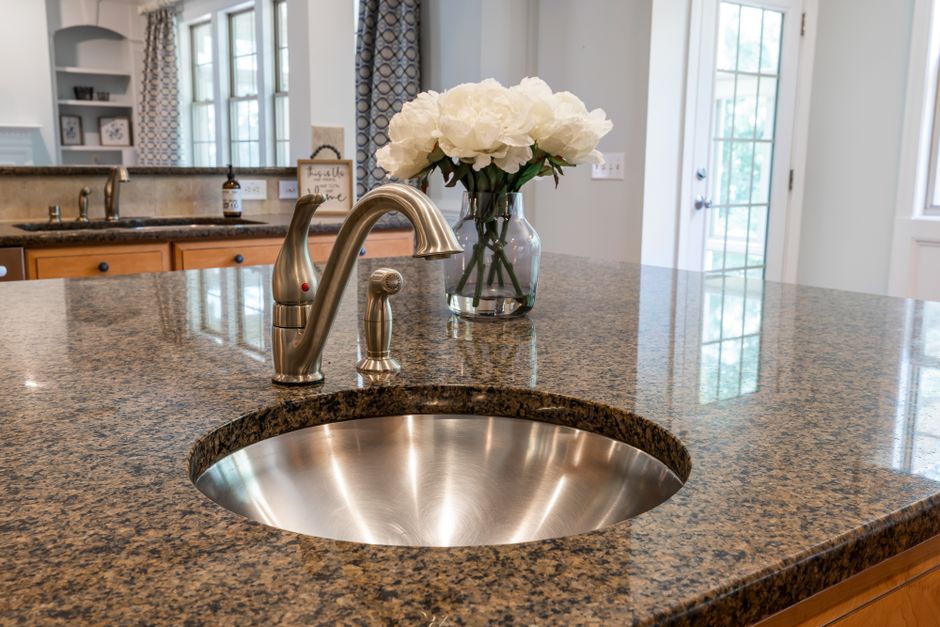
Granite can sometimes be installed over existing laminate, but only when the old top is flat, dry, solid, and square-edged, and when the extra height does not collide with your range, windows, or backsplash. In a Riverside kitchen, the answer depends less on the granite and more on what is hiding under the laminate. If any of the checks below fail, a full tear out is the safer job.
Start With the Edge of the Old Top
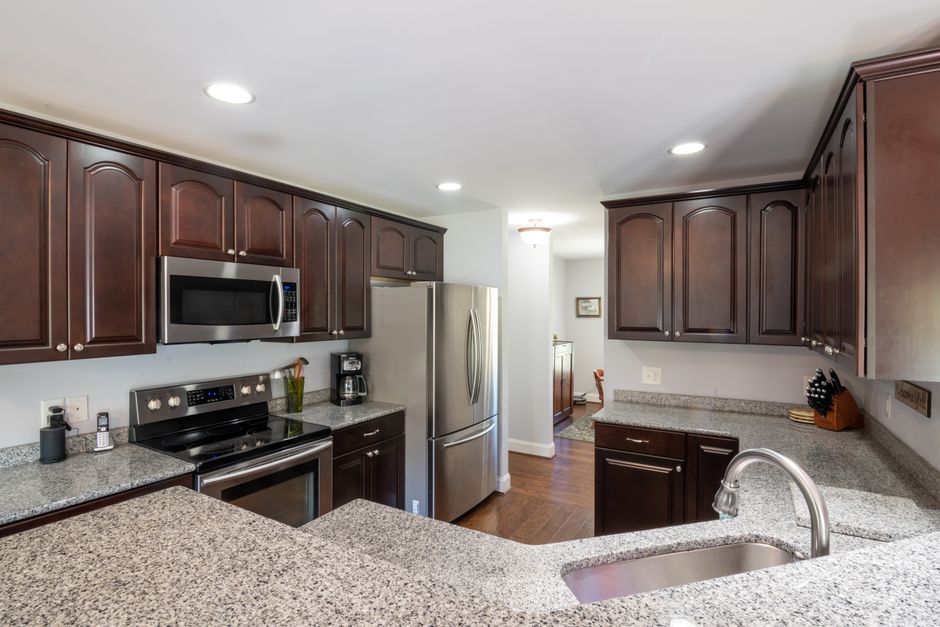
Overlay works only on a flat laminate top with a square edge. Many older tops have a rolled "no drip" front edge and a curved backsplash molded in one piece. Those curves have to be cut off, or the whole top has to come out, because stone needs flat, continuous support.
Run your hand along the front and the back of the counter. If the surface sweeps up into a curve at the wall or rolls over at the front, the top is not ready for stone as it stands. Cutting the curves away is possible on some tops, but it adds work and leaves a raw edge that must be hidden.
Press on the Laminate Around the Sink and Dishwasher
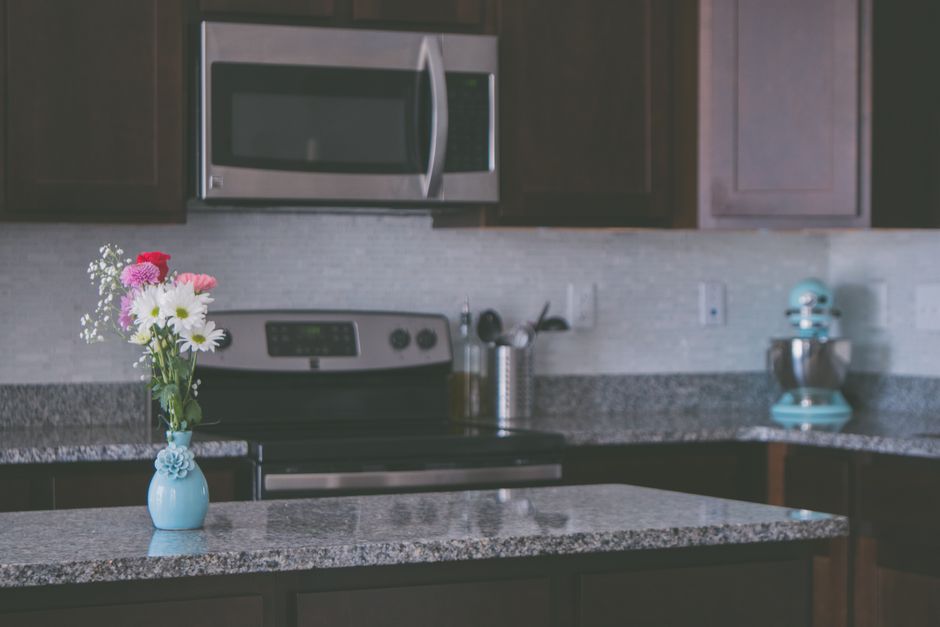
Most laminate is glued over particleboard, and particleboard swells and goes soft after slow leaks. Press firmly around the sink, the dishwasher, and the faucet. Soft, raised, or crumbly spots mean the substrate cannot carry stone, and the top should come out.
Riverside's dry air does not protect against this. The damage comes from leaks under the sink and around the dishwasher, not from humidity, so a dry climate is no reason to skip the check. Open the sink base and look at the underside of the top for staining, swelling, or dark rings.
Decide Whether the Cabinets Can Carry the Load
Granite is heavy, and in an overlay you also keep the weight of the old top. Most solid base cabinets handle it, but they still need a look. Check for these problems:
- Loose face frames
- Boxes that have racked out of square
- Water damaged cabinet bottoms
- Missing back rails or top stretchers
Cabinets in 1950s to 1970s Riverside homes may have been modified several times over the years, with sections cut for plumbing or moved during earlier remodels. Do not assume they are original or sound. A fabricator or installer should inspect them before the slab is ordered, not on install day.
Check That the Top Is Level
Stone needs a flat, level bed, or it can crack at cutouts and seams. A laminate top that has sagged or swelled passes that unevenness up to the stone. Shimming over an old top is less precise than shimming directly on the cabinet frames, which is one more reason a tear out often gives a better result.
Seam placement matters too. Seams in the new stone should not land directly over seams or weak joints in the old laminate. Movement in the substrate can show up later as a cracked or opened stone seam.
Plan for the Height Change
Laminate tops usually sit near 36 inches. An overlay adds the full thickness of the stone on top of the old surface. Using 2 cm stone (about 3/4 inch) adds that much, and a full 3 cm slab (about 1 1/4 inch) adds more. Measure the finished height before committing.
A tear out changes the math. A 3 cm slab placed directly on the cabinets ends up close to the original counter height, so the kitchen keeps its proportions. An overlay raises the counter noticeably, which affects seating, work comfort, and everything that sits against the counter.
Check the Range, Dishwasher, and Cutouts
Raising the counter affects appliances in ways that are easy to miss. Appliances will not fit the same after an overlay without remeasuring.
Range Height
A slide-in or freestanding range is meant to sit roughly level with the counter. Raise the counter and the cooktop can end up below the stone. Many ranges have adjustable leveling legs, but confirm the range can rise enough before you order.
Dishwasher Mounting
Dishwashers are usually screwed to the underside of the countertop through top brackets. Stone cannot take those screws, so the unit needs side mounting to the cabinets or a mounting kit made for stone. With an overlay, confirm the brackets still reach something solid.
Drop-In Cooktops and Sinks
Cutouts must go through both layers in an overlay, so the cooktop or sink rim rests on stacked material. Read the appliance installation guide for the cutout size and the required clearances from combustibles, and remeasure rather than relying on the old opening.
Think Hard About the Sink
A true undermount sink hangs from the underside of the stone. An overlay puts laminate and particleboard in the way, and their cut edges show at the sink opening and absorb water. Homeowners who want an undermount sink are usually better served by a full tear out.
A drop-in sink is more forgiving over an overlay, but the thicker deck still matters. Faucet shanks and mounting hardware must be long enough to reach through the added thickness, and older faucets may not reinstall cleanly. Riverside's hard water often leaves mineral buildup on old fixtures that makes them hard to remove and reseal, so this is a good time to replace them.
Look at the Backsplash, Windows, and Outlets
A molded laminate backsplash has to go. Raising the counter also shrinks the space between the counter and the upper cabinets, so tile layout, outlet boxes, and the bottom row of tile all shift. Measure the remaining gap and look at any outlets that will now sit close to the stone.
Windows deserve a check as well. In many ranch and tract kitchens, the window over the sink sits just above the counter. Added thickness can bring the stone into the sill or trim, so measure that clearance before deciding on overlay.
Hide the Old Edge and Support Any Overhang
In an overlay, the laminate edge sits under the granite edge and can show. Fabricators often use a deeper laminated or mitered stone edge to cover it. Ask to see how the finished front edge will look from both standing and seated height. An overlay does not look the same as a full slab install, and the edge is where the difference shows most.
Stone that extends past the cabinets for seating needs brackets or corbels beyond a small overhang. Thinner 2 cm material needs support sooner than 3 cm. An overlay does not change this requirement.
Know Which Overlay Product Is Being Quoted
"Overlay granite" can mean two different things. Thin prefabricated granite pieces made for overlay are a different product from full slabs cut to a template. The thin pieces rely heavily on adhesive and a sound substrate. Ask which one is in the quote, and ask what the installer will do if the old top turns out to be unsound once the sink is disconnected.
Secure the Stone for Earthquake Country
Granite is commonly set on silicone or adhesive rather than mechanically fastened. Riverside sits in an active seismic region, so make sure the stone is bonded properly and not just resting on the old top. Shaking can shift a loose top, and an overlay adds one more layer that has to stay bonded.
Overlay or Tear Out: A Practical Way to Decide
Overlay is worth considering when all of these are true: the laminate is flat with a square edge, the substrate is dry and firm, the cabinets are sound, and the extra height clears the range, window, and backsplash space. Overlay is not always the cheaper option overall once cutting, edge treatment, and appliance adjustments are counted, so compare the full scope rather than the slab alone.
Choose a full tear out when any of these show up: soft or swollen particleboard, a molded one-piece backsplash, a rolled front edge, a sagging surface, an undermount sink wish, or an appliance that cannot rise to the new height. Tear out also gives the installer a clean look at the cabinets, which is often when hidden problems come to light.
Care After Installation
Many granites benefit from periodic sealing. To check, place a little water on the surface and see whether it darkens the stone. Sealed granite resists stains but is not stainproof, and granite is not a place to set hot pans with no thought for risk.
Riverside's hard water leaves mineral rings around faucets and at the sink. Wipe the stone dry after use and clean with a pH neutral stone cleaner rather than acids or harsh scrubbing.